
Between Screen and Fabric: Martina Tiefenthaler on the Limits of the Digital World
News
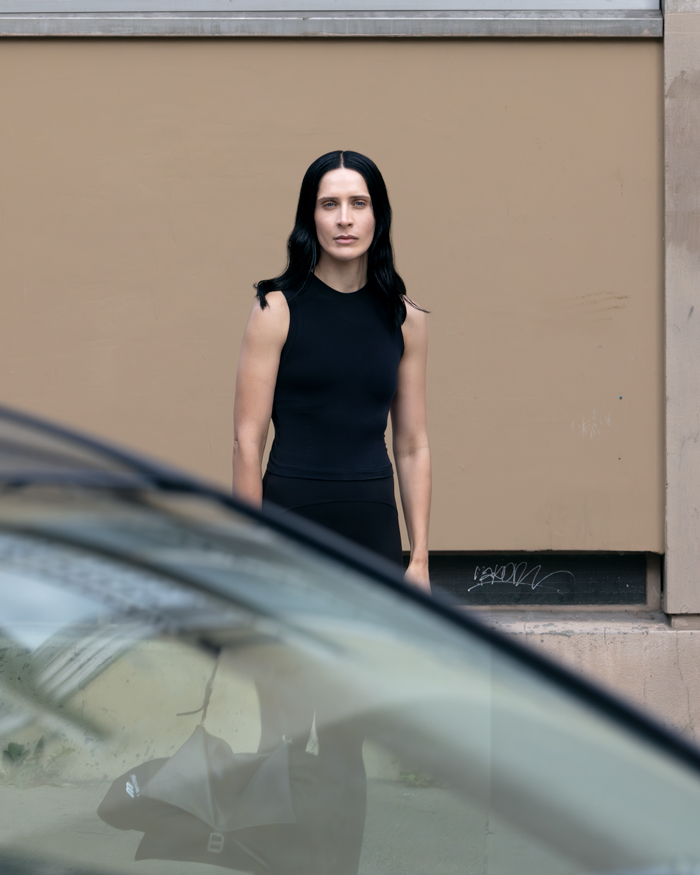
Photo: Winter Vandenbrink
How much craftsmanship does creativity require? Can we truly design analog objects digitally? And what role do personal experience and knowledge play in creative processes? As part of the “Artefakte” lecture series, Martina Tiefenthaler was a guest at the School of Design on 27th April 2026. In conversation with Simone Sommer, the designer and former Chief Creative Officer of Balenciaga offers personal insights into the fashion industry.
International and Multidisciplinary
Martina Tiefenthaler is one of the most influential creatives in the international fashion industry in recent years. The Austrian-born designer has a multidisciplinary background: After a brief stint in architecture in Innsbruck, she trained as a communication designer in Munich and eventually studied fashion design at the University of Applied Arts Vienna.
Her resume includes some of the most influential fashion houses, including Maison Martin Margiela, Louis Vuitton, Vetements, and Balenciaga. Her time at Balenciaga, in particular—where, as Chief Creative Officer, she helped shape the brand’s visual direction for over a decade—forms a central reference point in her work. Today, Tiefenthaler works as a creative consultant and coach. She advises brands on design, collection development, strategy, and image. As a coach, she supports creative professionals from various disciplines with problem-solving and career development.
First Jobs: Between Expectation and Reality
After completing her studies, an internship—which eventually turned into a job—took her to Maison Martin Margiela in Paris, an environment characterized by small teams. This gave her insight into every step of the collection design process, and she worked on a wide variety of tasks, ranging from mock-ups to collection concepts, as well as show and lookbook design. Looking back, she describes this time as a kind of “extended study period” in which theoretical knowledge and practical experience were closely intertwined.
At the same time, this entry into the industry confronted her with its real-world conditions: “That was before the introduction of a minimum wage for internships. I had no money, and there were mice in my apartment,” she recounts. Added to this were language barriers, as English alone didn’t get you very far in Paris back then.
She experienced a different side of the fashion industry after moving to Louis Vuitton: “The only thing it had in common with Margiela was that there was a studio and we designed clothes.” Louis Vuitton was highly structured, globally organized, and all the spaces were branded, Tiefenthaler recalls. “I felt out of place,” she admits, but it was precisely these experiences that shaped her. Situations that don’t fit are often the most instructive because they force you to clarify your own position.
Creativity Under Pressure
Her daily work routine changed once again with her role as Chief Creative Officer at Balenciaga. She was responsible for the brand’s visual direction—and 120 employees. This shifted the balance between creative freedom and administration. “Am I creative enough, or do I just have to get through the work?” This is how Tiefenthaler describes a fundamental conflict in the design profession that becomes particularly evident in leadership positions.
Using selected fashion shows from her time at Balenciaga, Tiefenthaler illustrates how fashion shows have changed in recent years and shares the insights she has drawn from them. Her favorite show, Fall Ready-to-Wear 2020, featured models seemingly walking on water—under an LED canopy that reflected in the water. With the Covid lockdown that followed shortly thereafter, this show seemed “apocalyptic” in hindsight. For Tiefenthaler, this is an example of how much the meaning of design can shift depending on the context.
Another example of digital innovation in fashion shows: the Fall 2021 Ready-to-Wear collection, which was presented entirely digitally. Realized as an interactive online game, it was not only technically challenging but also opened up new forms of presentation. The pressure to continually develop new formats and question existing systems is a constant companion in this process.
Return to the Analog: Craftsmanship as a Foundation
At the same time, Tiefenthaler emphasizes the importance of the analog. The relaunch of Balenciaga Couture 2021, in particular, was a turning point for her: small teams, new ateliers, intensive work with materials. “I was eager to engage more deeply with the design of fashion again, alongside commercial products,” she reveals. Long fitting days with a large team were organized. “If I want to design a tighter waistline, I want to be able to ask the model if they can still breathe.” Because this is precisely where she sees the limits of technology: when digital designs cannot be translated into the reality of craftsmanship, as she has often experienced in the atelier.
In her personal approach to technology, she has drawn conclusions. After working almost exclusively on her smartphone for a long time, she began consciously limiting her phone use. What has changed? “I can take things in much better. To be able to create, I have to be awake!” When it comes to artificial intelligence, she goes a step further and consciously avoids using it. “For me, it’s an experiment: How far can I go without AI?”
The evening made it clear that design and creativity today operate in a field of tension between digital acceleration and physical practice. Tiefenthaler’s perspective offers a nuanced view: what matters is how consciously one uses digital technology and how much space one continues to give to the analog.


