
Climate Protection Plan
Pforzheim University has developed an Integrated Energy and Climate Protection Concept (IEKK) that includes measures to reduce greenhouse gas emissions in order to contribute to climate protection on campus. The IEKK determines the energy and greenhouse gas balance, describes the current status of key areas of climate protection at Pforzheim University, and identifies potential areas for improvement and concrete measures.
The HS PF's Integrated Energy and Climate Protection Plan, as well as other documents related to energy management, are available in the download section.
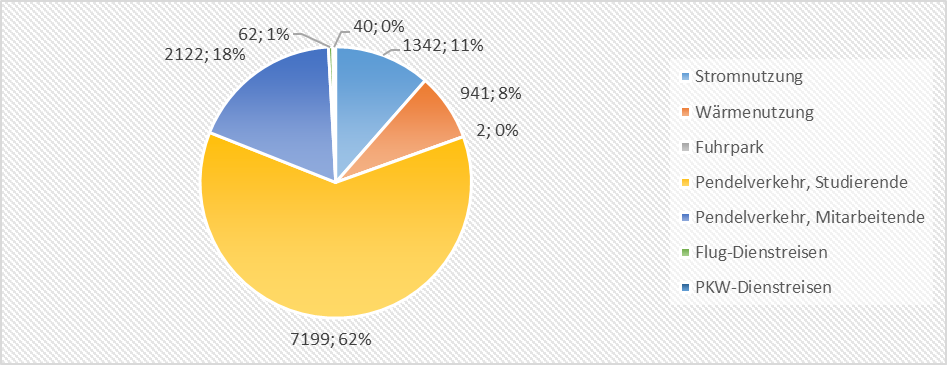
Pforzheim University calculates its greenhouse gas inventory based on the life cycle assessment methodology specified in ISO 14040/44. The following figure shows the breakdown of Pforzheim University’s greenhouse gas emissions in 2019 for selected sectors. Scope 3 (primarily the mobility sector) significantly dominates Pforzheim University’s greenhouse gas emissions. The pronounced impact of commuter traffic is particularly notable, accounting for approximately 80% of total greenhouse gas emissions. Electricity and heat consumption account for a total of about 20% of greenhouse gas emissions. Other emissions from the mobility sector, such as business trips and the university’s own vehicle fleet, contribute a total of 1% to total greenhouse gas emissions.
Detailed information on the methodology and approach used for the assessment can be found in the Integrated Energy and Climate Protection Concept.
During the development of the concept, all members of the university community were invited to participate, contribute ideas, and learn about the project. On December 14, 2022, the Energy and Climate Protection Concept was presented to the Senate of Pforzheim University, which unanimously acknowledged it favorably.
 Workshop Results
Workshop “Climate Protection at HS PF”
In December 2021, the Office of the Vice President for Energy Management and Climate Protection held several workshops on the topic of “Climate Protection at HS PF.” Approximately 60 professors, staff members, and students accepted the invitation and received information on the development of the IEKK. Following this, in a “World Café” format, they engaged in in-depth discussions about opportunities for climate protection at HS PF in the areas of mobility, energy, and everyday university life in general, and contributed ideas for potential climate protection measures. These results were assessed for feasibility and incorporated into the IEKK’s catalog of measures.
You can view the summary of the results from all workshops in a mind map here.
Information Day: Sustainability at HS PF
On June 1, 2022, the Office of the Vice President for Energy Management and Climate Protection hosted an information day focused on sustainability. All members of the university community were invited to present their sustainability initiatives. At the Office of the Vice Rector’s booth, students and staff could learn about the current status of the climate protection plan and the energy management system. Attendees also had the opportunity to submit additional ideas for climate protection via a suggestion box or to speak with Prorector Prof. Dr. Ingela Tietze and the Prorector’s Office team.
You can find highlights from the information day: Sustainability at HS PF here.
Please feel free to send us your ideas, comments, and questions by email at sustainability(at)hs-pforzheim(dot)de.
As part of the development of the IEKK, a catalog of measures consisting of 112 individual measures was compiled. Selected measures were evaluated in terms of savings potential, costs, and payback period. This catalog of measures serves as a basis for selecting appropriate climate protection measures and, thereby, for identifying transition pathways toward greenhouse gas-neutral operations at HS PF.
Initial climate protection measures have already been implemented or are currently being implemented:
- Expansion of the charging infrastructure for electric vehicles in combination with PV carports
- Procurement of additional pedelecs for employees’ business trips
- Internal climate levy for short-haul flights (under 700 km)
- Engagement and information initiatives for all university members, e.g., workshops, informational events, and lectures
- Kickoff events for students on the topics of climate protection and sustainability across all schools
- Gradual conversion of lighting to LED bulbs
- Digitization and expansion of the metering infrastructure at HS PF (electricity, heat, and water)
- Introduction and certification of an energy management system in accordance with DIN EN ISO 50001:2018
- Additional energy-saving measures were developed and implemented in response to the looming gas shortage. Some of these measures will remain in place in the future to save energy and thereby contribute to climate protection, such as optimizing heating and lighting controls. Information on the energy-saving measures can be found here.
A list of all individual measures, as well as further information on the catalog of measures, can be found in the Integrated Energy and Climate Protection Concept.


