
Study Examines the Evolution of Hydrogen Production Costs
News
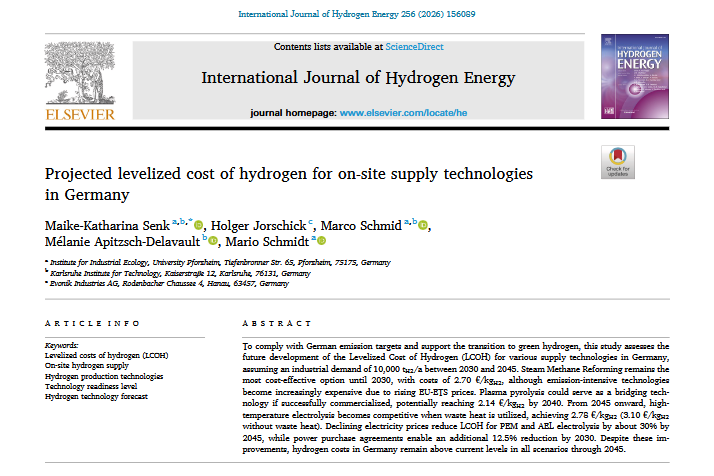
With the publication of the recent research article “Projected levelized cost of hydrogen for on-site supply technologies in Germany” in theInternational Journal of Hydrogen Energy, another important result from the H2Chemie2050 research project—which was conducted at INEC from 2022 to 2024—has been published.
Following our first article, “Hydrogen Dilemma,” which also appeared in the International Journal of Hydrogen Energy, this publication marks the second scientific paper to emerge from the project’s research.
Background
Hydrogen is considered a key building block for the decarbonization of energy-intensive industries. At the same time, significant uncertainties remain regarding the future economic viability of various production and supply pathways.
Against this backdrop, the present study examines the development of the levelized cost of hydrogen (LCOH) for ten different on-site supply technologies in Germany. The analysis covers an industrial hydrogen demand of 10,000 metric tons per year for the period from 2030 to 2045.
Key Findings
- Steam methane reforming (SMR) remains the most cost-effective technology through 2030 but is becoming increasingly less competitive due to rising CO₂ costs in the EU Emissions Trading System.
- Plasma pyrolysis could establish itself as an interesting bridge technology by 2040—provided that successful commercial scaling is achieved.
- Falling electricity prices will reduce the hydrogen production costs of electrolysis processes by about 30% by 2045.
- High-temperature electrolysis (SOEC) will reach a competitive cost level by 2045, particularly when utilizing industrial waste heat.
- Power Purchase Agreements (PPAs) offer additional potential for cost reduction and improve the economic viability of green hydrogen production.
Implications for Industrial Transformation
The results illustrate that the long-term competitiveness of hydrogen technologies depends significantly on developments in the electricity markets, CO₂ prices, and technological progress. While fossil-fuel-based processes still offer economic advantages in the short term, low-emission and renewable hydrogen pathways are becoming increasingly important in the long term.
The study thus contributes to the discussion on the future hydrogen supply for German industry and supports the assessment of potential transformation pathways toward climate-neutral production.
Read the article: https://doi.org/10.1016/j.ijhydene.2026.156089
Article “Hydrogen Dilemma”:https://doi.org/10.1016/j.ijhydene.2025.150660


