
Mira Kim Wins the 2026 Herbert Hofmann Prize
News
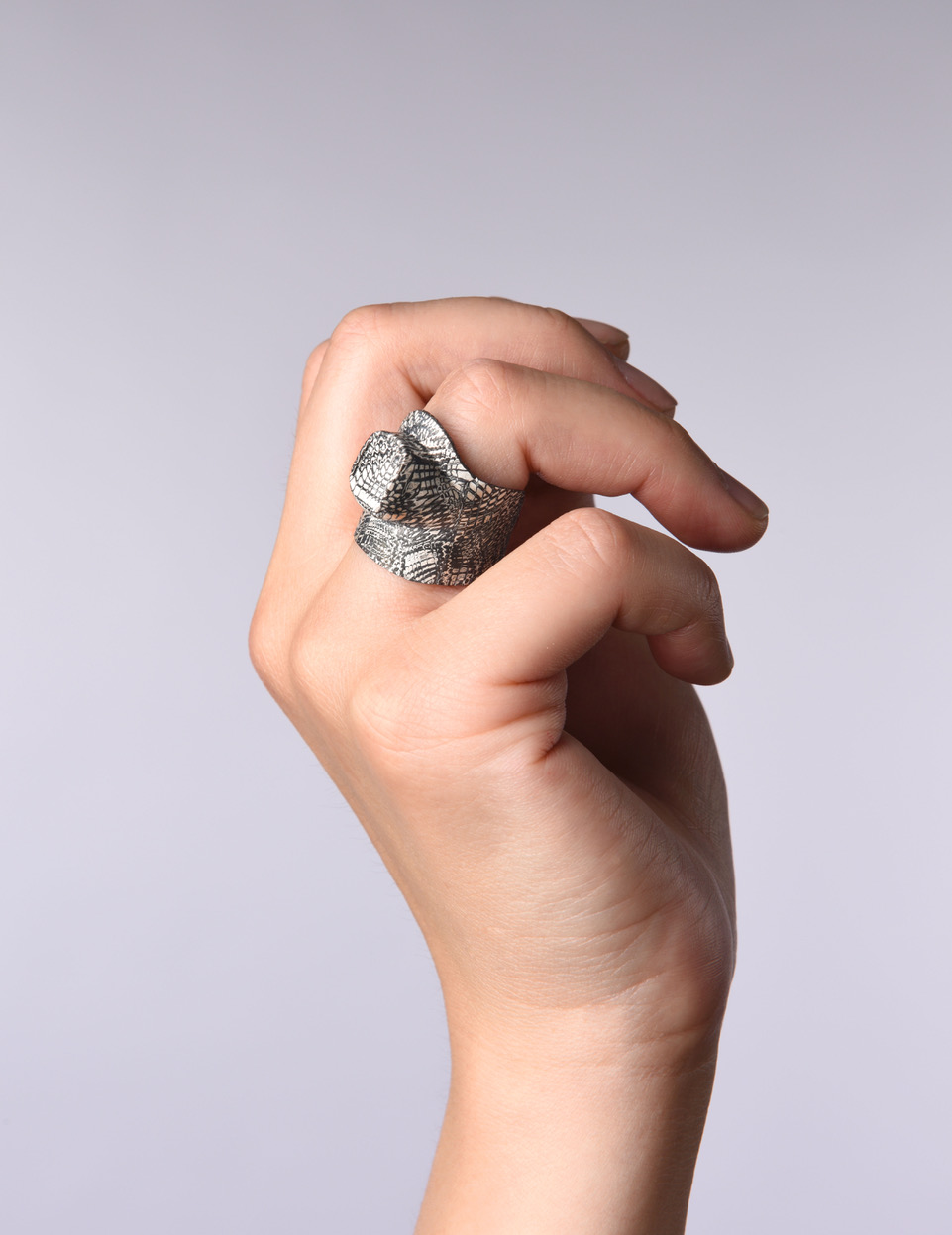
Photo: Petra Jaschke
Jewelry designer Mira Kim has won the prestigious 2026 Herbert Hofmann Prize. In her work, she combines the techniques of mokume-gane and guilloché with sensitivity and great mastery. Kim is a former research fellow in the Jewelry Design program at Pforzheim University and a fellow of the PF Revisited Berlin Artist Residency 2023 program. This program aims to preserve traditional craftsmanship techniques in jewelry production, for which the fellow was granted the opportunity to work at the German Museum of Technology in Berlin for four months. In addition, she participated in the 2020 Designers in Residence fellowship program of the City of Pforzheim, which is awarded in cooperation with the Faculty of Design.
The Herbert Hofmann Prize honors outstanding designer jewelry. It is awarded annually as part of the International Craft Fair in Munich during the Special Jewelry Exhibition. A rotating international jury selects the three prize winners from among the participants in the special exhibition. This exhibition is curated by rotating artists and designers—this year, Sam Tho Duong, an alumnus of the Jewelry program, had the honor. The special exhibition is sponsored by the Danner Foundation.
In its commendation, the jury highlights the innovative use of traditional jewelry techniques: “[Mira Kim] is honored for a delicate ring created using the Mokume-gane technique. The technique is traditionally employed in a highly ordered manner. Here, however, the artist explores new possibilities. In her ring, differently colored metal alloys swirl into ornamental forms, overlaid with engraved patterns produced using the almost forgotten Guilloché technique.”
During her time as a Research Fellow and while on the PF Revisited Fellowship, Mira Kim engaged intensively with the techniques for which she has now been honored in her current work. The Mokume-gane forging technique has its historical and cultural roots in the Asian context; Guilloché engraving is a technique developed in 19th-century Europe that has retained its significance to this day.
Mira Kim on her work and the process:
“Techniques are more than just tools of production; they have been shaped by the historical and cultural context of their respective eras. I view these techniques as materials, as elements that can be reassembled to explore new forms of expression. This project focuses not only on uncovering the expressive potential of each individual technique, but also on examining the intersections of the historical and cultural layers in which they operated.
In particular, I have studied guilloché in Pforzheim and at the Technisches Museum Berlin, analyzed the working notes of master guillocheur Walter Zaiss, and experimented with his methods. This dialogue between different times and spaces reflects how traditional practices can be reconfigured and transformed to speak to the present.
The creative process involves repeatedly engraving the layered Mokume-gane metal sheets with a guilloché machine and subsequently deconstructing these engravings by flattening them. The engraved lines, derived from precise calculations, create patterns that are both consistent and fragmented, generating a dynamic tension between perfection and imperfection, structure and unpredictability.”
An interview with Mira Kim at KLIMT02 can be found here: https://klimt02.net/videos/mira-kim-winner-herbert-hofmann-preis-2026-interviewed-klimt02


