
Admissible evidence preservation through distributed technologies
News
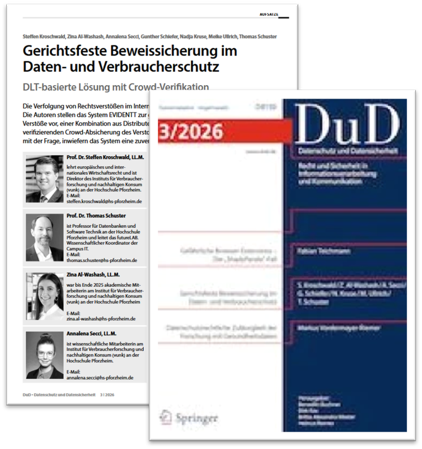
Prosecution of legal violations on the internet often fails due to a lack of evidence. Digital content is highly ephemeral and susceptible to manipulation. When legal violations are detected—for example, by affected parties, advocacy organizations, or government agencies—they must be documented for use as evidence in court. In the case of online violations, this is often done through screenshots. However, manipulations relevant to the evidence can occur during or before the creation of a screenshot: by rewriting the underlying source code of a website. Or by altering the screenshot itself, whether through subsequent image editing or the use of AI-based methods such as deepfakes.
Case law and scientific analyses point to the limited evidentiary value of screenshots. As part of the EVIDENTT study—a collaborative project between the vunk Institute at Pforzheim University and the AIFB Institute at KIT, conducted as part of the Blockchain Ideas Competition on behalf of the Baden-Württemberg Foundation—the feasibility of a technical solution for reliable and legally admissible documentation of legal violations in the digital space was demonstrated.
In a newly published article in the Journal of Data Protection and Data Security, the project participants present the EVIDENTT system: a combination of distributed ledger technology (DLT) and crowd-verified validation of the violation. The article focuses on the question of to what extent the system can support reliable, privacy-friendly, and above all legally admissible—i.e., compliant with judicial rules of evidence—documentation of legal violations in the digital space.
Kroschwald, S./Schuster, T./Al-Washash, Z./Secci, A./Kruse, N./Ullrich, M./Schiefer, G., Court-Admissible Preservation of Evidence in Data and Consumer Protection – DLT-Based Solution with Crowd Verification, DuD 3/2026, pp. 145–151


